
Vision, Mission, And Core Values Are More Than Just Words
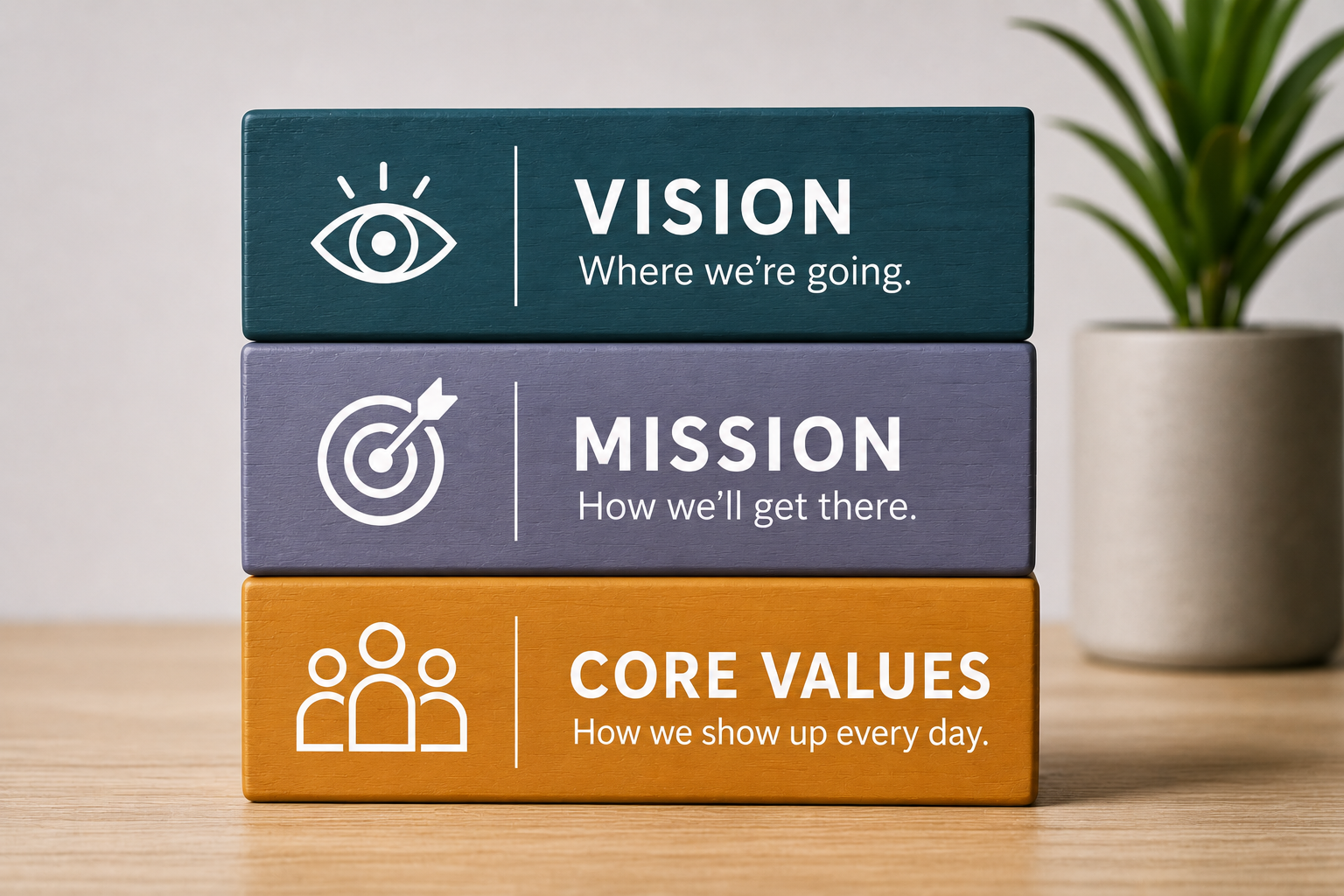
It is quite common for organizations to have a vision, mission and core values. However, many organizations fall short of leveraging them to build success. Too often, they get created and posted on the company website or placed on a wall and that’s it.
In fact, a 2024 Gallop poll found that only 30% of employees feel connected to their company's mission/purpose, which is a record low. This happens when the mission, vision, and core values have not been incorporated into the fabric of the business.
The most common reasons why include when they…
Lack clarity and a unified vision
Do not align with organizational operations
Are not communicated widely
When utilized correctly, your mission, vision and core values should anchor your business by providing a common framework as well as inspiration for individuals at all levels in your organization. They are the building blocks of your workforce culture and your strategic plan.
A Vision is your organization’s desired end state:
Description or Big Picture of where you are going and what it will look like when it gets there.
It should be big, bold and provide the inspiration to help you succeed!
One sentence that is clear and concise.
The Mission of your organization tells you how you will achieve your vision. It provides information regarding your organization's leadership style, how you measure success, and defines your priorities, actions and responsibilities.
Your Mission Statement should be:
Plausible: It is a big picture representation that should tie back broadly to your everyday operations.
Readable: Keep it simple, avoid unnecessarily big words or complex sentences.
Have a Compelling Voice: Use active language that reflects the unique culture of your organization and build conviction around your core values. A mission statement is typically one sentence that is clear and concise.
Core Values are a set of fundamental beliefs, ideals or practices that inform an organization how to allocate resources, make important decisions and grow. They:
Bring clarity to what matters most in your organization
Build conviction for both your organization and the customers it serves
Set the tone for behaviors
Be easily understood
Most organizations will have between 3-5 core values that includes a brief explanation for each value. They should be clear, concise and align with the mission and vision.
In all cases it is important to keep things simple! In this case, less is more. For example, LinkedIn, the world’s largest on-line professional network platform, has a very simple vision and mission that resonates with their services and brand. It was crafted to speak to all their members (1 billion +) in more than 200 hundred countries world-wide:
Vision: To create economic opportunity for every member of the global workforce.
Mission: To connect the world’s professionals to make them more productive and successful.
Another great example is HubSpot, which offers an all-in-one CRM platform for business marketing, sales and service needs. They have over 3,000 employees and have been awarded as a top workplace by multiple publications.
Mission: To help companies “grow with a conscience and succeed with a soul.”
They say their employees are full of HEART, which stands for Humble, Empathetic, Adaptable, Remarkable, and Transparent. Additionally, their values are:
We solve for the customer.
We work to be remarkably transparent.
We favor autonomy & accountability.
We believe our best perk is amazing peers.
We lean towards long-term impact.
Both of these companies are good examples of how the mission, vision and core values of an organization can be used to anchor their culture, strategic plans and communicate a unified and clear message to their employees and customers.
Conclusion
Building culture is not a one-time initiative. It is an ongoing intentional practice that requires commitment and consistency. But the return on investment is enormous: stronger engagement, better performance, greater loyalty, and a more resilient, future-ready organization. Plus, in today’s environment where employees seek, purpose, connection and trust, your culture, which is unique to your organization, can give you a competitive edge.
I can help leaders strengthen their culture from the inside out, connecting values to action and people to purpose. If you're ready to build or refresh the culture in your organization, contact me to start the conversation.
📚 References
Harter, J. (2025, March 14). The post-pandemic workplace: The experiment continues. Gallup. https://www.gallup.com/workplace/657629/post-pandemic-workplace-experiment-continues.aspx
LinkedIn Corporation. (n.d.). About LinkedIn. https://about.linkedin.com/'
HubSpot. (n.d.). The HubSpot Culture Code. https://www.hubspot.com/culture-code/the-hubspot-culture-code
